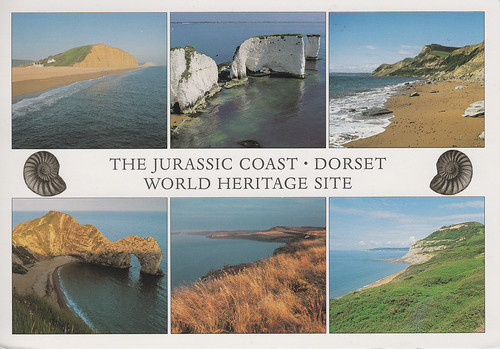
The cliff exposures along the Dorset and East Devon coast provide an almost continuous sequence of rock formations spanning the Mesozoic Era, or some 185 million years of the earth's history. The area's important fossil sites and classic coastal geomorphologic features have contributed to the study of earth sciences for over 300 years.
Date of Inscription: 2001
further Informations: http://whc.unesco.org/en/list/1029
Showing posts with label United Kingdom - 28. Show all posts
10/06/2014
14/05/2014
United Kingdom - Maritime Greenwich
The ensemble of buildings at Greenwich, an outlying district of London, and the park in which they are set, symbolize English artistic and scientific endeavour in the 17th and 18th centuries. The Queen's House (by Inigo Jones) was the first Palladian building in England, while the complex that was until recently the Royal Naval College was designed by Christopher Wren. The park, laid out on the basis of an original design by André Le Nôtre, contains the Old Royal Observatory, the work of Wren and the scientist Robert Hooke.
Date of Inscription: 1997
further Informations: http://whc.unesco.org/en/list/795
Date of Inscription: 1997
further Informations: http://whc.unesco.org/en/list/795
| JuneRR - 28 - boldnerd |
09/08/2013
United Kingdom - Heart of Neolithic Orkney
The group of Neolithic monuments on Orkney consists of a large chambered tomb (Maes Howe), two ceremonial stone circles (the Stones of Stenness and the Ring of Brodgar) and a settlement (Skara Brae), together with a number of unexcavated burial, ceremonial and settlement sites. The group constitutes a major prehistoric cultural landscape which gives a graphic depiction of life in this remote archipelago in the far north of Scotland some 5,000 years ago.
Date of Inscription: 1999
United Kingdom - Old and New Towns of Edinburgh
Edinburgh has been the Scottish capital since the 15th century. It has two distinct areas: the Old Town, dominated by a medieval fortress; and the neoclassical New Town, whose development from the 18th century onwards had a far-reaching influence on European urban planning. The harmonious juxtaposition of these two contrasting historic areas, each with many important buildings, is what gives the city its unique character.
Date of Inscription: 1995
further Informations: http://whc.unesco.org/en/list/728
visited in 2013
visited in 2013
United Kingdom - St Kilda
This volcanic archipelago, with its spectacular landscapes, is situated off the coast of the Hebrides and comprises the islands of Hirta, Dun, Soay and Boreray. It has some of the highest cliffs in Europe, which have large colonies of rare and endangered species of birds, especially puffins and gannets. The archipelago, uninhabited since 1930, bears the evidence of more than 2,000 years of human occupation in the extreme conditions prevalent in the Hebrides. Human vestiges include built structures and field systems, the cleits and the traditional Highland stone houses. They feature the vulnerable remains of a subsistence economy based on the products of birds, agriculture and sheep farming.
Date of Inscription: 1986
further informations: http://whc.unesco.org/en/list/387
| DecemberRR - 10 - cardsgoround |
12/07/2013
United Kingdom - Palace of Westminster and Westminster Abbey including Saint Margaret’s Church
Westminster Palace, rebuilt from the year 1840 on the site of important medieval remains, is a fine example of neo-Gothic architecture. The site – which also comprises the small medieval Church of Saint Margaret, built in Perpendicular Gothic style, and Westminster Abbey, where all the sovereigns since the 11th century have been crowned – is of great historic and symbolic significance.
Date of Inscription: 1987
further Informations: http://whc.unesco.org/en/list/426/
Date of Inscription: 1987
further Informations: http://whc.unesco.org/en/list/426/
| unwritten |
United Kingdom - Tower of London
The massive White Tower is a typical example of Norman military architecture, whose influence was felt throughout the kingdom. It was built on the Thames by William the Conqueror to protect London and assert his power. The Tower of London – an imposing fortress with many layers of history, which has become one of the symbols of royalty – was built around the White Tower.
DAte of Inscription: 1988
further Informations: http://whc.unesco.org/en/list/488
United Kingdom - Stonehenge, Avebury and Associated Sites
Stonehenge and Avebury, in Wiltshire, are among the most famous groups of megaliths in the world. The two sanctuaries consist of circles of menhirs arranged in a pattern whose astronomical significance is still being explored. These holy places and the nearby Neolithic sites are an incomparable testimony to prehistoric times.
Date of Inscription: 1986
further Informations: http://whc.unesco.org/en/list/373
United Kingdom - Royal Botanic Gardens, Kew
This historic landscape garden features elements that illustrate significant periods of the art of gardens from the 18th to the 20th centuries. The gardens house botanic collections (conserved plants, living plants and documents) that have been considerably enriched through the centuries. Since their creation in 1759, the gardens have made a significant and uninterrupted contribution to the study of plant diversity and economic botany.
Date of Inscription: 2003
further Informations: http://whc.unesco.org/en/list/1084
Date of Inscription: 2003
further Informations: http://whc.unesco.org/en/list/1084
| big unesco - 42 - poncha |
United Kingdom - New Lanark
New Lanark is a small 18th- century village set in a sublime Scottish landscape where the philanthropist and Utopian idealist Robert Owen moulded a model industrial community in the early 19th century. The imposing cotton mill buildings, the spacious and well-designed workers' housing, and the dignified educational institute and school still testify to Owen's humanism.
Date of Inscription: 2001
further Informations: http://whc.unesco.org/en/list/429
United Kingdom - Liverpool – Maritime Mercantile City
Six areas in the historic centre and docklands of the maritime mercantile City of Liverpool bear witness to the development of one of the world’s major trading centres in the 18th and 19th centuries. Liverpool played an important role in the growth of the British Empire and became the major port for the mass movement of people, e.g. slaves and emigrants from northern Europe to America. Liverpool was a pioneer in the development of modern dock technology, transport systems and port management. The listed sites feature a great number of significant commercial, civic and public buildings, including St George’s Plateau.
Date of Inscription: 2004
List of Danger: 2012
further Informations: http://whc.unesco.org/en/list/1150
| FB-swap with gilly |
United Kingdom - Ironbridge Gorge
Ironbridge is known throughout the world as the symbol of the Industrial Revolution. It contains all the elements of progress that contributed to the rapid development of this industrial region in the 18th century, from the mines themselves to the railway lines. Nearby, the blast furnace of Coalbrookdale, built in 1708, is a reminder of the discovery of coke. The bridge at Ironbridge, the world's first bridge constructed of iron, had a considerable influence on developments in the fields of technology and architecture.
Date of Inscription: 1986
further Informations: http://whc.unesco.org/en/list/371
United Kingdom - Giant's Causeway and Causeway Coast
The Giant's Causeway lies at the foot of the basalt cliffs along the sea coast on the edge of the Antrim plateau in Northern Ireland. It is made up of some 40,000 massive black basalt columns sticking out of the sea. The dramatic sight has inspired legends of giants striding over the sea to Scotland. Geological studies of these formations over the last 300 years have greatly contributed to the development of the earth sciences, and show that this striking landscape was caused by volcanic activity during the Tertiary, some 50–60 million years ago.
Date of Inscription: 1986
| JulyRR - 15 - chrissybaby |
Germany - United Kingdom - Frontiers of the Roman Empire
More views from Limes are always welcome!
The ‘Roman Limes’ represents the border line of the Roman Empire at its greatest extent in the 2nd century AD. It stretched over 5,000 km from the Atlantic coast of northern Britain, through Europe to the Black Sea, and from there to the Red Sea and across North Africa to the Atlantic coast. The remains of the Limes today consist of vestiges of built walls, ditches, forts, fortresses, watchtowers and civilian settlements. Certain elements of the line have been excavated, some reconstructed and a few destroyed. The two sections of the Limes in Germany cover a length of 550 km from the north-west of the country to the Danube in the south-east. The 118-km-long Hadrian’s Wall (UK) was built on the orders of the Emperor Hadrian c. AD 122 at the northernmost limits of the Roman province of Britannia. It is a striking example of the organization of a military zone and illustrates the defensive techniques and geopolitical strategies of ancient Rome. The Antonine Wall, a 60-km long fortification in Scotland was started by Emperor Antonius Pius in 142 AD as a defense against the “barbarians” of the north. It constitutes the northwestern-most portion of the Roman Limes.
Date of Inscription: 1987
Extension: 2005,2008
| China x OC RR 25 - rec from gerschjg in Aug 2011. The card shows the Römerkastell Saalburg in Bad Homburg |
| received from Andy | Housesteads mile fort, northumberland |
United Kingdom - Durham Castle and Cathedral
Durham Cathedral was built in the late 11th and early 12th centuries to house the relics of St Cuthbert (evangelizer of Northumbria) and the Venerable Bede. It attests to the importance of the early Benedictine monastic community and is the largest and finest example of Norman architecture in England. The innovative audacity of its vaulting foreshadowed Gothic architecture. Behind the cathedral stands the castle, an ancient Norman fortress which was the residence of the prince-bishops of Durham.
Date of Inscription: 1986
further Informations: http://whc.unesco.org/en/list/370
| MarciaRay |
United Kingdom - Derwent Valley Mills
The Derwent Valley in central England contains a series of 18th- and 19th- century cotton mills and an industrial landscape of high historical and technological interest. The modern factory owes its origins to the mills at Cromford, where Richard Arkwright's inventions were first put into industrial-scale production. The workers' housing associated with this and the other mills remains intact and illustrate the socio-economic development of the area.
Date of Inscription: 2001
further Informations: http://whc.unesco.org/en/list/1030
United Kingdom - City of Bath
Founded by the Romans as a thermal spa, Bath became an important centre of the wool industry in the Middle Ages. In the 18th century, under George III, it developed into an elegant town with neoclassical Palladian buildings, which blend harmoniously with the Roman baths.
Date of Inscription: 1987
further Informations: http://whc.unesco.org/en/list/428
United Kingdom - Castles and Town Walls of King Edward in Gwynedd
The castles of Beaumaris and Harlech (largely the work of the greatest military engineer of the time, James of St George) and the fortified complexes of Caernarfon and Conwy are located in the former principality of Gwynedd, in north Wales. These extremely well-preserved monuments are examples of the colonization and defence works carried out throughout the reign of Edward I (1272–1307) and the military architecture of the time.
Date of Inscription: 1986
further Informations: http://whc.unesco.org/en/list/374
| private swap mistyweather |
Subscribe to:
Posts (Atom)