Showing posts with label Indonesia - 7. Show all posts

14/04/2014

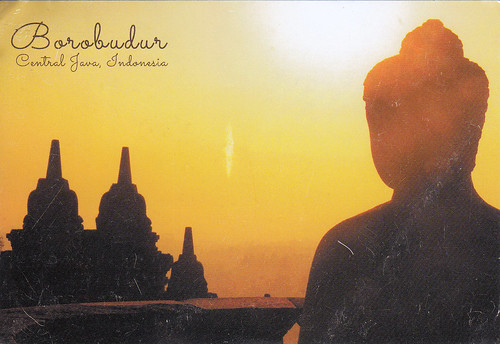
Indonesia - Borobudur Temple Compounds


This famous Buddhist temple, dating from the 8th and 9th centuries, is located in central Java. It was built in three tiers: a pyramidal base with five concentric square terraces, the trunk of a cone with three circular platforms and, at the top, a monumental stupa. The walls and balustrades are decorated with fine low reliefs, covering a total surface area of 2,500 m2. Around the circular platforms are 72 openwork stupas, each containing a statue of the Buddha. The monument was restored with UNESCO's help in the 1970s.

Date of Inscription: 1991 


Borobudur Temple Compounds
ID-89051
Stamps on the Card with the ID ID-89051
The Stamp on Top shows the other Indonesian UNESCO Site Prambanan Temples


Borobudur Temple Compounds


Borobudur Temple Compounds


Borobudur Temple Compounds


12/10/2011

Indonesia - Prambanan Temple Compounds

Built in the 10th century, this is the largest temple compound dedicated to Shiva in Indonesia. Rising above the centre of the last of these concentric squares are three temples decorated with reliefs illustrating the epic of the Ramayana, dedicated to the three great Hindu divinities (Shiva, Vishnu and Brahma) and three temples dedicated to the animals who serve them.

Date of Inscription: 1991
further Informations: http://whc.unesco.org/en/list/642


Prambanan Temple Compounds
BIG Unesco RR #21 - bunana


unesco0910_0003
Many Themes RR #428 - bunana


1st post issued: 06 Oct 2011
Edited: 12 Oct 2011

06/10/2011

Ujung Kulon National Park - Indonesia

This national park, located in the extreme south-western tip of Java on the Sunda shelf, includes the Ujung Kulon peninsula and several offshore islands and encompasses the natural reserve of Krakatoa. In addition to its natural beauty and geological interest – particularly for the study of inland volcanoes – it contains the largest remaining area of lowland rainforests in the Java plain. Several species of endangered plants and animals can be found there, the Javan rhinoceros being the most seriously under threat.
Date of Inscription: 1991


Postcard 1: Rec from Shinta
  Ujung Kulon National Park


Sangiran Early Man Site - Indonesia

Excavations here from 1936 to 1941 led to the discovery of the first hominid fossil at this site. Later, 50 fossils of Meganthropus palaeo and Pithecanthropus erectus/Homo erectus were found – half of all the world's known hominid fossils. Inhabited for the past one and a half million years, Sangiran is one of the key sites for the understanding of human evolution. 


Date of Inscription: 1996


Postcard 1: from shinta
  Sangiran Early Man Site


Lorentz National Park - Indonesia

Lorentz National Park (2.35 million ha) is the largest protected area in South-East Asia. It is the only protected area in the world to incorporate a continuous, intact transect from snowcap to tropical marine environment, including extensive lowland wetlands. Located at the meeting-point of two colliding continental plates, the area has a complex geology with ongoing mountain formation as well as major sculpting by glaciation. The area also contains fossil sites which provide evidence of the evolution of life on New Guinea, a high level of endemism and the highest level of biodiversity in the region.


  • Date of Inscription: 1999
Postcard 1: private swap with shinta


Lorentz National Park


Komodo National Park - Indonesia

These volcanic islands are inhabited by a population of around 5,700 giant lizards, whose appearance and aggressive behaviour have led to them being called 'Komodo dragons'. They exist nowhere else in the world and are of great interest to scientists studying the theory of evolution. The rugged hillsides of dry savannah and pockets of thorny green vegetation contrast starkly with the brilliant white sandy beaches and the blue waters surging over coral.


  • Date of Inscription: 1991
Postcard 1: unwritten
Komodo National Park