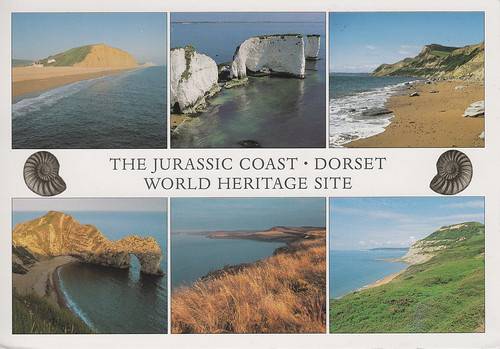
The cliff exposures along the Dorset and East Devon coast provide an almost continuous sequence of rock formations spanning the Mesozoic Era, or some 185 million years of the earth's history. The area's important fossil sites and classic coastal geomorphologic features have contributed to the study of earth sciences for over 300 years.
Date of Inscription: 2001
further Informations: http://whc.unesco.org/en/list/1029
Showing posts with label 2001. Show all posts
10/06/2014
06/03/2014
Austria - Historic Centre of Vienna
Vienna developed from early Celtic and Roman settlements into a Medieval and Baroque city, the capital of the Austro-Hungarian Empire. It played an essential role as a leading European music centre, from the great age of Viennese Classicism through the early part of the 20th century. The historic centre of Vienna is rich in architectural ensembles, including Baroque castles and gardens, as well as the late-19th-century Ringstrasse lined with grand buildings, monuments and parks.
Year of Inscription: 2001
further Informations: http://whc.unesco.org/en/list/1033
Year of Inscription: 2001
further Informations: http://whc.unesco.org/en/list/1033
| Andrea |
| Unesco RR #95 from bine |
| Capital City RR #4 from ? |
| RAS card from Robin67 - Vienna State Oper |
Austria - Fertö / Neusiedlersee Cultural Landscape
The Fertö/Neusiedler Lake area has been the meeting place of different cultures for eight millennia. This is graphically demonstrated by its varied landscape, the result of an evolutionary symbiosis between human activity and the physical environment. The remarkable rural architecture of the villages surrounding the lake and several 18th- and 19th-century palaces adds to the area’s considerable cultural interest.
Year of Inscription: 2001
further Informations: http://whc.unesco.org/en/list/772
Year of Inscription: 2001
further Informations: http://whc.unesco.org/en/list/772
| Nina |
| Andrea |
| unwritten |
22/07/2013
Poland - Churches of Peace in Jawor and Świdnica
The Churches of Peace in Jawor and Świdnica, the largest timber-framed religious buildings in Europe, were built in the former Silesia in the mid-17th century, amid the religious strife that followed the Peace of Westphalia. Constrained by the physical and political conditions, the Churches of Peace bear testimony to the quest for religious freedom and are a rare expression of Lutheran ideology in an idiom generally associated with the Catholic Church.
Date of Inscription: 2001
further Informations: http://whc.unesco.org/en/list/1054
Portugal - Historic Centre of Guimarães
The historic town of Guimarães is associated with the emergence of the Portuguese national identity in the 12th century. An exceptionally well-preserved and authentic example of the evolution of a medieval settlement into a modern town, its rich building typology exemplifies the specific development of Portuguese architecture from the 15th to 19th century through the consistent use of traditional building materials and techniques.
Date of Inscription: 2001
further Informations: http://whc.unesco.org/en/list/1031
Date of Inscription: 2001
further Informations: http://whc.unesco.org/en/list/1031
Portugal - Alto Douro Wine Region
Wine has been produced by traditional landholders in the Alto Douro region for some 2,000 years. Since the 18th century, its main product, port wine, has been world famous for its quality. This long tradition of viticulture has produced a cultural landscape of outstanding beauty that reflects its technological, social and economic evolution.
Date of Inscription: 2001
further informations: http://whc.unesco.org/en/list/1046
Date of Inscription: 2001
further informations: http://whc.unesco.org/en/list/1046
| RAS from Diana |
13/07/2013
Switzerland - Swiss Alps Jungfrau-Aletsch
The extension of the natural World Heritage property of Jungfrau - Aletsch - Bietschhorn (first inscribed in 2001), expands the site to the east and west, bringing its surface area up to 82,400 ha., up from 53,900. The site provides an outstanding example of the formation of the High Alps, including the most glaciated part of the mountain range and the largest glacier in Eurasia. It features a wide diversity of ecosystems, including successional stages due particularly to the retreat of glaciers resulting from climate change. The site is of outstanding universal value both for its beauty and for the wealth of information it contains about the formation of mountains and glaciers, as well as ongoing climate change. It is also invaluable in terms of the ecological and biological processes it illustrates, notably through plan succession. Its impressive landscape has played an important role in European art, literature, mountaineering and alpine tourism.
Date of Inscription: 2001
further Informations: http://whc.unesco.org/en/list/1037
Visited: Every once in a while
Date of Inscription: 2001
further Informations: http://whc.unesco.org/en/list/1037
Visited: Every once in a while
12/07/2013
United Kingdom - New Lanark
New Lanark is a small 18th- century village set in a sublime Scottish landscape where the philanthropist and Utopian idealist Robert Owen moulded a model industrial community in the early 19th century. The imposing cotton mill buildings, the spacious and well-designed workers' housing, and the dignified educational institute and school still testify to Owen's humanism.
Date of Inscription: 2001
further Informations: http://whc.unesco.org/en/list/429
United Kingdom - Derwent Valley Mills
The Derwent Valley in central England contains a series of 18th- and 19th- century cotton mills and an industrial landscape of high historical and technological interest. The modern factory owes its origins to the mills at Cromford, where Richard Arkwright's inventions were first put into industrial-scale production. The workers' housing associated with this and the other mills remains intact and illustrate the socio-economic development of the area.
Date of Inscription: 2001
further Informations: http://whc.unesco.org/en/list/1030
03/12/2011
Israel - Masada
Masada is a rugged natural fortress, of majestic beauty, in the Judaean Desert overlooking the Dead Sea. It is a symbol of the ancient kingdom of Israel, its violent destruction and the last stand of Jewish patriots in the face of the Roman army, in 73 A.D. It was built as a palace complex, in the classic style of the early Roman Empire, by Herod the Great, King of Judaea, (reigned 37 – 4 B.C.). The camps, fortifications and attack ramp that encircle the monument constitute the most complete Roman siege works surviving to the present day.
Date of Inscription: 2001
Postcard 1: private swap with Oleg, received in November 2011
10/11/2011
Russia - Central Sikhote-Alin
The Sikhote-Alin mountain range contains one the richest and most unusual temperate forests of the world. In this mixed zone between taiga and subtropics, southern species such as the tiger and Himalayan bear cohabit with northern species such as the brown bear and lynx. The site stretches from the peaks of Sikhote-Alin to the Sea of Japan and is important for the survival of many endangered species such as the Amur tiger.
Date of Inscription: 2001
Postcard 1: BIG UNESCO RR 9 from reddew
Date of Inscription: 2001
Postcard 1: BIG UNESCO RR 9 from reddew
08/11/2011
Morocco - Medina of Essaouira (formerly Mogador)
Essaouira is an exceptional example of a late-18th-century fortified town, built according to the principles of contemporary European military architecture in a North African context. Since its foundation, it has been a major international trading seaport, linking Morocco and its Saharan hinterland with Europe and the rest of the world.
Date of Inscription: 2001
07/10/2011
Provins, Town of Medieval Fairs - France
The fortified medieval town of Provins is situated in the former territory of the powerful Counts of Champagne. It bears witness to early developments in the organization of international trading fairs and the wool industry. The urban structure of Provins, which was built specifically to host the fairs and related activities, has been well preserved.
Date of Inscription: 2001
Postcard 1: BIG Unesco RR #7 from nathj92
Date of Inscription: 2001
Postcard 1: BIG Unesco RR #7 from nathj92
28/09/2011
Zollverein Coal Mine Industrial Complex in Essen - Germany
The Zollverein industrial complex in Land Nordrhein-Westfalen consists of the complete infrastructure of a historical coal-mining site, with some 20th-century buildings of outstanding architectural merit. It constitutes remarkable material evidence of the evolution and decline of an essential industry over the past 150 years.
Date of Inscription: 2001
Postcard 1: Present from xtelera at the Bielefeld International Meetup #1
Postcard 2: Zollverein XII, unwritten
Date of Inscription: 2001
Postcard 1: Present from xtelera at the Bielefeld International Meetup #1
Postcard 2: Zollverein XII, unwritten
Subscribe to:
Posts (Atom)


