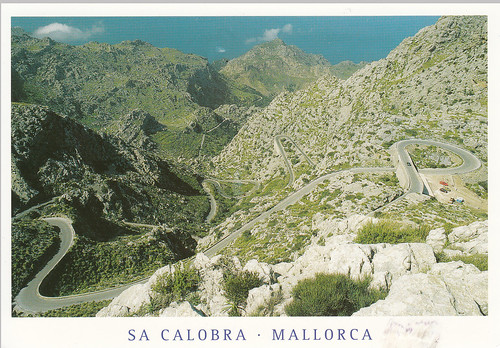
The Cultural Landscape of the Serra de Tramuntana located on a sheer-sided mountain range parallel to the north-western coast of the island of Mallorca. Millennia of agriculture in an environment with scarce resources has transformed the terrain and displays an articulated network of devices for the management of water revolving around farming units of feudal origins. The landscape is marked by agricultural terraces and inter-connected water works - including water mills - as well as dry stone constructions and farms.
Year of Inscription: 2011
further Informations: http://whc.unesco.org/en/list/1371
Showing posts with label 2011. Show all posts
16/07/2014
23/06/2014
Germany - Monastic Island of Reichenau
The island of Reichenau on Lake Constance preserves the traces of the Benedictine monastery, founded in 724, which exercised remarkable spiritual, intellectual and artistic influence. The churches of St Mary and Marcus, St Peter and St Paul, and St George, mainly built between the 9th and 11th centuries, provide a panorama of early medieval monastic architecture in central Europe. Their wall paintings bear witness to impressive artistic activity.
Date of Inscription: 2000
further Informations: http://whc.unesco.org/en/list/974
Visited in: 2011
Date of Inscription: 2000
further Informations: http://whc.unesco.org/en/list/974
Visited in: 2011
| WriteBackRR - 5 . dogma |
29/03/2014
Jordan - Wadi Rum Protected Area
The 74,000-hectare property, inscribed as a mixed natural and cultural site, is situated in southern Jordan, near the border with Saudi Arabia. It features a varied desert landscape consisting of a range of narrow gorges, natural arches, towering cliffs, ramps, massive landslides and caverns. Petroglyphs, inscriptions and archaeological remains in the site testify to 12,000 years of human occupation and interaction with the natural environment. The combination of 25,000 rock carvings with 20,000 inscriptions trace the evolution of human thought and the early development of the alphabet. The site illustrates the evolution of pastoral, agricultural and urban activity in the region.
Date of Inscription: 2011
further Informations: http://whc.unesco.org/en/list/1377
Date of Inscription: 2011
further Informations: http://whc.unesco.org/en/list/1377
![]() |
| swap with Mervat |
09/03/2014
Australia - Ningaloo Coast
The 604,500 hectare marine and terrestrial property of Ningaloo Coast, on the remote western coast of Australia, includes one of the longest near-shore reefs in the world. On land the site features an extensive karst system and network of underground caves and water courses. Annual gatherings of whale sharks occur at Ningaloo Coast, which is home to numerous marine species, among them a wealth of sea turtles. The terrestrial part of the site features subterranean water bodies with a substantial network of caves, conduits, and groundwater streams. They support a variety of rare species that contribute to the exceptional biodiversity of the marine and terrestrial site
Year of Inscription: 2011
further Informations: http://whc.unesco.org/en/list/1369
Year of Inscription: 2011
further Informations: http://whc.unesco.org/en/list/1369
![]() |
| Heather |
![]() |
| Heather |
![]() |
| Heather |
06/03/2014
Austria - France - Germany - Italy - Slovenia - Switzerland - Prehistoric Pile dwellings around the Alps
This serial property of 111 small individual sites encompasses the remains of prehistoric pile-dwelling (or stilt house) settlements in and around the Alps built from around 5000 to 500 B.C. on the edges of lakes, rivers or wetlands. Excavations, only conducted in some of the sites, have yielded evidence that provides insight into life in prehistoric times during the Neolithic and Bronze Age in Alpine Europe and the way communities interacted with their environment. Fifty-six of the sites are located in Switzerland. The settlements are a unique group of exceptionally well-preserved and culturally rich archaeological sites, which constitute one of the most important sources for the study of early agrarian societies in the region.
Year of Inscription: 2011
further Informations: http://whc.unesco.org/en/list/1363
Year of Inscription: 2011
further Informations: http://whc.unesco.org/en/list/1363
SWITZERLAND
20/07/2013
Ukraine - Residence of Bukovinian and Dalmatian Metropolitans
The Residence of Bukovinian and Dalmatian Metropolitans represents a masterful synergy of architectural styles built by Czech architect Josef Hlavka from 1864 to 1882. The property, an outstanding example of 19th-century historicist architecture, also includes a seminary and monastery and is dominated by the domed, cruciform Seminary Church with a garden and park. The complex expresses architectural and cultural influences from the Byzantine period onward and embodies the powerful presence of the Orthodox Church during Habsburg rule, reflecting the Austro-Hungarian Empire policy of religious tolerance.
Date of inscription: 2011
further Informations: http://whc.unesco.org/en/list/1330
16/07/2013
United Arab Emirates - Cultural Sites of Al Ain (Hafit, Hili, Bidaa Bint Saud and Oases Areas)
The Cultural Sites of Al Ain (Hafit, Hili, Bidaa Bint Saud and Oases Areas) constitute a serial property that testifies to sedentary human occupation of a desert region since the Neolithic period with vestiges of many prehistoric cultures. Remarkable vestiges in the property include circular stone tombs (ca 2500 B.C.), wells and a wide range of adobe constructions: residential buildings, towers, palaces and administrative buildings. Hili moreover features one of the oldest examples of the sophisticated aflaj irrigation system which dates back to the Iron Age. The property provides important testimony to the transition of cultures in the region from hunting and gathering to sedentarization.
Date of Inscription: 2011
further Informations: http://whc.unesco.org/en/list/1343
25/01/2012
West Lake Cultural Landscape of Hangzhou - China
The West Lake Cultural Landscape of Hangzhou, comprising the West Lake and the hills surrounding its three sides, has inspired famous poets, scholars and artists since the 9th century. It comprises numerous temples, pagodas, pavilions, gardens and ornamental trees, as well as causeways and artificial islands. These additions have been made to improve the landscape west of the city of Hangzhou to the south of the Yangtze river. The West Lake has influenced garden design in the rest of China as well as Japan and Korea over the centuries and bears an exceptional testimony to the cultural tradition of improving landscapes to create a series of vistas reflecting an idealised fusion between humans and nature.
Date of Inscription: 2011
Postcard 1: received from SeptemberRR - 20 - Duhnizlong
Date of Inscription: 2011
Postcard 1: received from SeptemberRR - 20 - Duhnizlong
Postcard 2: private swap with twentyajax, received november 2011
Postcard 3: Unesco Tag - mottstreet, January 2012
17/10/2011
Longobards in Italy. Places of the power (568-774 A.D.) - Italy
The Longobards in Italy, Places of Power, 568 - 774 A.D. comprises seven groups of important buildings (including fortresses, churches, and monasteries) throughout the Italian Peninsula. They testify to the high achievement of the Lombards, who migrated from northern Europe and developed their own specific culture in Italy where they ruled over vast territories in the 6th to 8th centuries. The Lombards synthesis of architectural styles marked the transition from Antiquity to the European Middle Ages, drawing on the heritage of Ancient Rome, Christian spirituality, Byzantine influence and Germanic northern Europe. The serial property testifies to the Lombards' major role in the spiritual and cultural development of Medieval European Christianity, notably by bolstering the monastic movement.
Date of Inscription: 2011
Postcard 1: rec 07 Oct 2011 via private swap from Gosia
07/10/2011
The Causses and the Cévennes, Mediterranean agro-pastoral Cultural Landscape - france
The 302,319 hectare property, in the southern part of central France, is a mountain landscape interspersed by deep valleys that is representative of the relationship between agro-pastoral systems and their biophysical environment, notably through drailles or drove roads. Villages and substantial stone farmhouses on deep terraces of the Causses reflect the organization of large abbeys from the 11th century. Mont Lozère, inside the property, is one of the last places where summer transhumance is still practiced.
Date of Inscription: 2011
Postcard 1: private swap with vykorbfan
Date of Inscription: 2011
Postcard 1: private swap with vykorbfan
26/09/2011
Hiraizumi – Temples, Gardens and Archaeological Sites Representing the Buddhist Pure Land - Japan
Hiraizumi - Temples, Gardens and Archaeological Sites Representing the Buddhist Pure Land comprises five sites, including the sacred Mount Kinkeisan. It features vestiges of government offices dating from the 11th and 12th centuries when Hiraizumi was the administrative centre of the northern realm of Japan and rivalled Kyoto. The realm was based on the cosmology of Pure Land Buddhism, which spread to Japan in the 8th century. It represented the pure land of Buddha that people aspire to after death, as well as peace of mind in this life. In combination with indigenous Japanese nature worship and Shintoism, Pure Land Buddhism developed a concept of planning and garden design that was unique to Japan.
Date of Inscription: 2011
| Postcard 1: MeetUp RR #50B from tinktink0302 |
Subscribe to:
Posts (Atom)