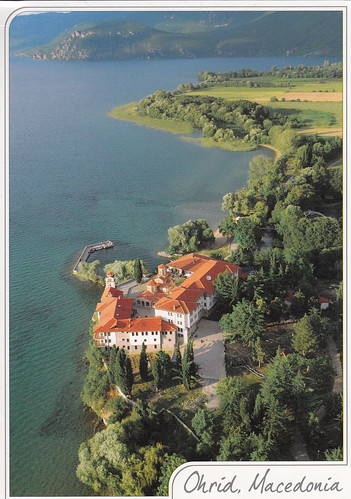
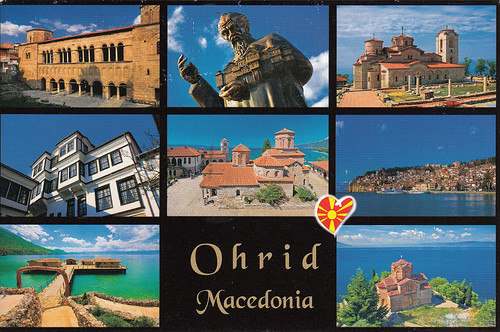
Situated on the shores of Lake Ohrid, the town of Ohrid is one of the oldest human settlements in Europe. Built mainly between the 7th and 19th centuries, it has the oldest Slav monastery (St Pantelejmon) and more than 800 Byzantine-style icons dating from the 11th to the end of the 14th century. After those of the Tretiakov Gallery in Moscow, this is considered to be the most important collection of icons in the world
Year of Inscription: 1979
further Informations: http://whc.unesco.org/en/list/99
Showing posts with label 1979. Show all posts
12/10/2014
24/06/2014
Bulgaria - Thracian Tomb of Kazanlak
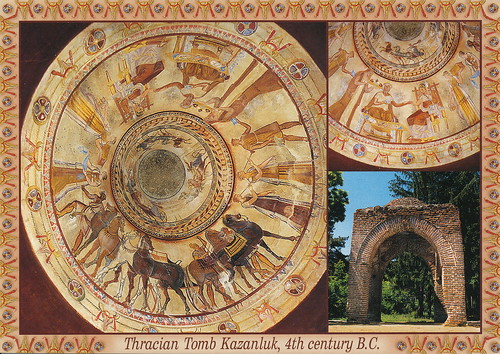
Discovered in 1944, this tomb dates from the Hellenistic period, around the end of the 4th century BC. It is located near Seutopolis, the capital city of the Thracian king Seutes III, and is part of a large Thracian necropolis. The tholos has a narrow corridor and a round burial chamber, both decorated with murals representing Thracian burial rituals and culture. These paintings are Bulgaria’s best-preserved artistic masterpieces from the Hellenistic period.
Year of Inscription: 1979
Further Informations: http://whc.unesco.org/en/list/44
Year of Inscription: 1979
Further Informations: http://whc.unesco.org/en/list/44
20/06/2014
Bulgaria - Rock-Hewn Churches of Ivanovo
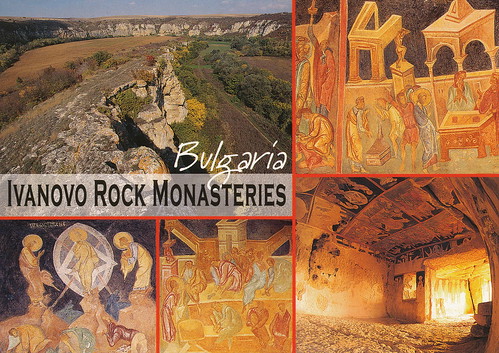
In the valley of the Roussenski Lom River, in north east Bulgaria, a complex of rock-hewn churches, chapels, monasteries and cells developed in the vicinity of the village of Ivanovo. This is where the first hermits had dug out their cells and churches during the 12th century. The 14th-century murals testify to the exceptional skill of the artists belonging to the Tarnovo School of painting.
Year of Inscription: 1979
Further Informations: http://whc.unesco.org/en/list/45
Year of Inscription: 1979
Further Informations: http://whc.unesco.org/en/list/45
18/06/2014
Bulgaria - Madara Rider
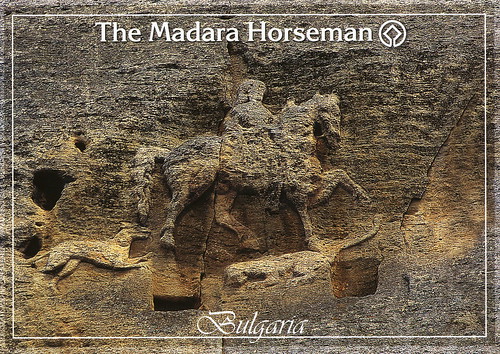
The Madara Rider, representing the figure of a knight triumphing over a lion, is carved into a 100-m-high cliff near the village of Madara in north-east Bulgaria. Madara was the principal sacred place of the First Bulgarian Empire before Bulgaria’s conversion to Christianity in the 9th century. The inscriptions beside the sculpture tell of events that occurred between AD 705 and 801.
Year of Inscription: 1979
further Informations: http://whc.unesco.org/en/list/43
Year of Inscription: 1979
further Informations: http://whc.unesco.org/en/list/43
01/06/2014
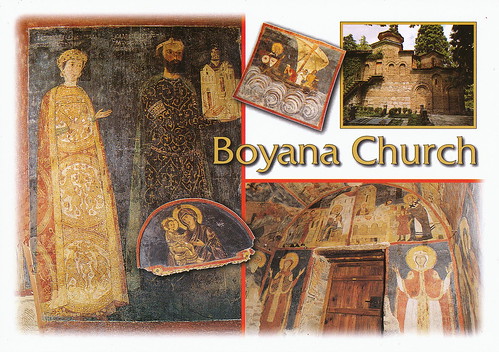
Bulgaria - Boyana Church
Located on the outskirts of Sofia, Boyana Church consists of three buildings. The eastern church was built in the 10th century, then enlarged at the beginning of the 13th century by Sebastocrator Kaloyan, who ordered a second two storey building to be erected next to it. The frescoes in this second church, painted in 1259, make it one of the most important collections of medieval paintings. The ensemble is completed by a third church, built at the beginning of the 19th century. This site is one of the most complete and perfectly preserved monuments of east European medieval art.
Year of Inscription: 1979
further Informations: http://whc.unesco.org/en/list/42
Year of Inscription: 1979
further Informations: http://whc.unesco.org/en/list/42
17/02/2014
Guatemala - Tikal National Park
In the heart of the jungle, surrounded by lush vegetation, lies one of the major sites of Mayan civilization, inhabited from the 6th century B.C. to the 10th century A.D. The ceremonial centre contains superb temples and palaces, and public squares accessed by means of ramps. Remains of dwellings are scattered throughout the surrounding countryside.
Date of Inscription: 1979
further Informations: http://whc.unesco.org/en/list/64
Date of Inscription: 1979
further Informations: http://whc.unesco.org/en/list/64
14/08/2013
Canada - USA - Kluane / Wrangell-St. Elias / Glacier Bay / Tatshenshini-Alsek
These parks comprise an impressive complex of glaciers and high peaks on both sides of the border between Canada (Yukon Territory and British Columbia) and the United States (Alaska). The spectacular natural landscapes are home to many grizzly bears, caribou and Dall's sheep. The site contains the largest non-polar icefield in the world.
Year of Inscription: 1979
further Informations: http://whc.unesco.org/en/list/72/
Year of Inscription: 1979
further Informations: http://whc.unesco.org/en/list/72/
![]() |
28/07/2013
Tunisia - Archaeological Site of Carthage
Carthage was founded in the 9th century B.C. on the Gulf of Tunis. From the 6th century onwards, it developed into a great trading empire covering much of the Mediterranean and was home to a brilliant civilization. In the course of the long Punic wars, Carthage occupied territories belonging to Rome, which finally destroyed its rival in 146 B.C. A second – Roman – Carthage was then established on the ruins of the first.
Date of Inscription: 1979
further Informtions: http://whc.unesco.org/en/list/37
27/07/2013
Tunisia - Amphitheatre of El Jem
The impressive ruins of the largest colosseum in North Africa, a huge amphitheatre which could hold up to 35,000 spectators, are found in the small village of El Jem. This 3rd-century monument illustrates the grandeur and extent of Imperial Rome.
Date of Inscription: 1979
further informations: http://whc.unesco.org/en/list/38
22/07/2013
Poland - Auschwitz Birkenau German Nazi Concentration and Extermination Camp (1940-1945)
The fortified walls, barbed wire, platforms, barracks, gallows, gas chambers and cremation ovens show the conditions within which the Nazi genocide took place in the former concentration and extermination camp of Auschwitz-Birkenau, the largest in the Third Reich. According to historical investigations, 1.5 million people, among them a great number of Jews, were systematically starved, tortured and murdered in this camp, the symbol of humanity's cruelty to its fellow human beings in the 20th century.
Date of Inscription: 1979
further Informations: http://whc.unesco.org/en/list/31
19/07/2013
Serbia - Stari Ras and Sopoćani
On the outskirts of Stari Ras, the first capital of Serbia, there is an impressive group of medieval monuments consisting of fortresses, churches and monasteries. The monastery at Sopoćani is a reminder of the contacts between Western civilization and the Byzantine world.
Year of Inscription:1979
further Informations: http://whc.unesco.org/en/list/96
Year of Inscription:1979
further Informations: http://whc.unesco.org/en/list/96
| private swap with caki |
13/07/2013
Tunisia - Medina of Tunis
Under the Almohads and the Hafsids, from the 12th to the 16th century, Tunis was considered one of the greatest and wealthiest cities in the Islamic world. Some 700 monuments, including palaces, mosques, mausoleums, madrasas and fountains, testify to this remarkable past.
Date of Inscription: 1979
further Informations: http://whc.unesco.org/en/list/36
12/07/2013
USA - Grand Canyon National Park
Carved out by the Colorado River, the Grand Canyon (nearly 1,500 m deep) is the most spectacular gorge in the world. Located in the state of Arizona, it cuts across the Grand Canyon National Park. Its horizontal strata retrace the geological history of the past 2 billion years. There are also prehistoric traces of human adaptation to a particularly harsh environment.
Date of Inscription: 1979
| US-1466376 |
| unwritten |
| US-1367427 |
| February Alternative RR #3 - 07 - Aurora |
| Mountain RR - alimx007 |
| MarchRR - 28 - aurora |
25/01/2012
USA - Independence Hall
The Declaration of Independence (1776) and the Constitution of the United States (1787) were both signed in this building in Philadelphia. The universal principles of freedom and democracy set forth in these documents are of fundamental importance to American history and have also had a profound impact on law-makers around the world.
| BIG Unesco RR - traveling envelope - 45 |
Croatia - Old City of Dubrovnik
The 'Pearl of the Adriatic', situated on the Dalmatian coast, became an important Mediterranean sea power from the 13th century onwards. Although severely damaged by an earthquake in 1667, Dubrovnik managed to preserve its beautiful Gothic, Renaissance and Baroque churches, monasteries, palaces and fountains. Damaged again in the 1990s by armed conflict, it is now the focus of a major restoration programme co-ordinated by UNESCO.
06/12/2011
Croatia - Historical Complex of Split with the Palace of Diocletian
The ruins of Diocletian's Palace, built between the late 3rd and the early 4th centuries A.D., can be found throughout the city. The cathedral was built in the Middle Ages, reusing materials from the ancient mausoleum. Twelfth- and 13th-century Romanesque churches, medieval fortifications, 15th-century Gothic palaces and other palaces in Renaissance and Baroque style make up the rest of the protected area.
Date of Inscription: 1979
Postcard 1: RAS from crna_ofca
Date of Inscription: 1979
Postcard 1: RAS from crna_ofca
08/11/2011
Belarus, Poland - Belovezhskaya Pushcha / Białowieża Forest
Situated on the watershed of the Baltic Sea and the Black Sea, this immense forest range, consisting of evergreens and broad-leaved trees, is home to some remarkable animal life, including rare mammals such as the wolf, the lynx and the otter, as well as some 300 European Bison, a species which has been reintroduced into the park.
Date of Inscription: 1979
Postcard 1: UNESCO RR #96 - evelayn
Date of Inscription: 1979
Postcard 1: UNESCO RR #96 - evelayn
07/11/2011
Nepal - Kathmandu Valley
The cultural heritage of the Kathmandu Valley is illustrated by seven groups of monuments and buildings which display the full range of historic and artistic achievements for which the Kathmandu Valley is world famous. The seven include the Durbar Squares of Hanuman Dhoka (Kathmandu), Patan and Bhaktapur, the Buddhist stupas of Swayambhu and Bauddhanath and the Hindu temples of Pashupati and Changu Narayan.
Date of inscription: 1979
Nepal - Sagarmatha National Park
Sagarmatha is an exceptional area with dramatic mountains, glaciers and deep valleys, dominated by Mount Everest, the highest peak in the world (8,848 m). Several rare species, such as the snow leopard and the lesser panda, are found in the park. The presence of the Sherpas, with their unique culture, adds further interest to this site.
Date of Inscription: 1979
Postcard 1: from my parents
Date of Inscription: 1979
Postcard 1: from my parents
06/10/2011
Prehistoric Sites and Decorated Caves of the Vézère Valley - France
I was in France again last Summer (2011), and had on my must see plan the lascaux grottes. Unfortunately they were closed exactly on the day i've planned to visit them :( it would be such an interesting site for me... maybe you know the the lascaux colors? i used them for many of my paintings i did in the past... well maybe in a few years... but first we have other countries to visit... (i was to many times in france already ;) )
The Vézère valley contains 147 prehistoric sites dating from the Palaeolithic and 25 decorated caves. It is particularly interesting from an ethnological and anthropological, as well as an aesthetic point of view because of its cave paintings, especially those of the Lascaux Cave, whose discovery in 1940 was of great importance for the history of prehistoric art. The hunting scenes show some 100 animal figures, which are remarkable for their detail, rich colours and lifelike quality.
- Date of Inscription: 1979
Subscribe to:
Posts (Atom)